
Water Categories and Classes Explained
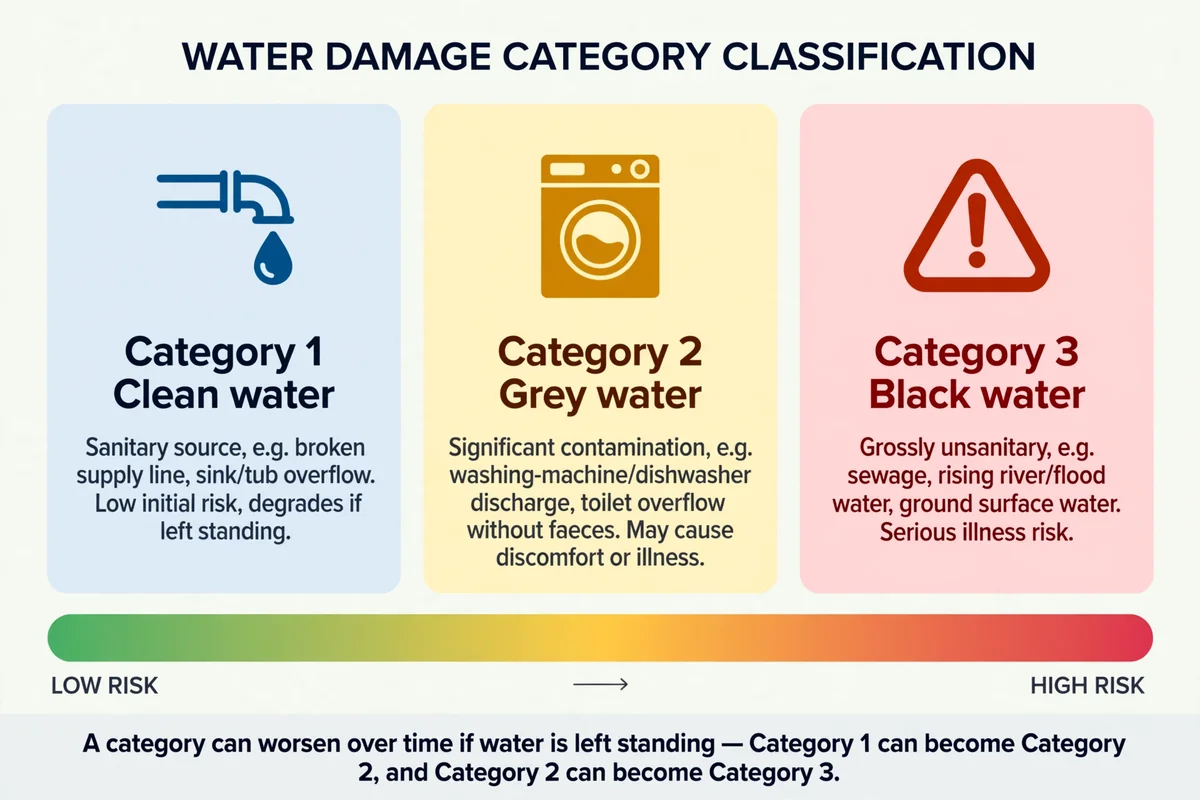
Water categories and classes answer two different questions about a leak. The category describes how dirty the water is: Category 1 is clean, Category 2 is gray, and Category 3 is black water, which can include sewage or flood water. A category can get worse the longer water sits, so a fast check matters.
24/7 — call any time • Serving 27 Wichita ZIP codes • Local Wichita water damage team
What are the three water categories?
The three water categories describe how dirty the water is, not how much damage it has done yet. Category 1 is clean water from a source like a broken supply line or a hot water tank leak. Category 2 is gray water, which has some dirt or soap in it, such as water from a washing machine or a dishwasher. Category 3 is black water, which is grossly unsanitary and can include sewage, flood water from outside, or water that has sat long enough to pick up harmful matter.
That last point is why time matters. Water that starts clean does not stay clean forever. Once it runs across a dirty floor, soaks into building materials, or sits for a day or more, our team may treat it as a higher category. This is one reason we ask when the leak started and what the water touched, rather than just asking how big the wet spot looks.
In Wichita, the June 2026 flash flooding is a clear example of why the source matters. KSN TV reported up to 6 inches of rain overnight across the Wichita area in June 2026, with flooded streets and cars. Water that comes in from outside during a flood is treated as Category 3, even if it looks fairly clear in a living room. A separate fact from that same night shows the scale: Wichita Fire ran 180 calls in 10 hours, with 60 percent water-related.
What is the difference between a category and a class?
In water categories and classes, a category answers one question: how dirty is the water? A class answers a different question: how much water is there, and how far did it spread? A small, clean leak on a tile floor and a large, clean leak that soaked carpet, padding, and sheet rock can share the same category and still need very different drying work.
Class 1 means the least amount of water spread, often limited to part of a room with little absorption into walls or floors. Class 2 means a whole room or a larger area is wet, including carpet and some wall material. Class 3 means water came from above or spread widely, soaking ceilings, walls, and floors. Class 4 means water has soaked deep into materials that dry slowly, such as hardwood, plaster, or concrete.
People often mix these two ideas up and ask whether a higher class means a higher price. A class is about how much water and how far it spread, not a price. Costs depend on the work quoted for your home; ask for an itemized quote. For a plain view of what drives cost, see the money page linked below.
How does a Wichita cause point to a category and a class?
Start with the source, then look at the spread. A burst supply pipe to a sink is usually Category 1 at first, and the class depends on whether water stayed on a hard floor or ran under cabinets and into sheet rock. A washing machine overflow is often Category 2 because the water carries detergent and dirt, and the class rises if it spreads across a laundry room and into a hall. A sewer backup or rising flood water is Category 3 from the start.
That distinction matters in Wichita because the Arkansas River and the MS Mitch Mitchell Floodway, known locally as the Big Ditch, shape how flood water moves around the city. The Sedgwick County flood factsheet covers water and stormwater facts for the county, and it is worth reading before you assume a street flood is just rain water.
The table below pulls this together. It is a plain guide, not a diagnosis for your home. Our team, who can see the water, test moisture, and check what it touched, makes the call on site. If you are unsure about the source, treat the water with care, keep children and pets out of it, and get our team to look before you start pulling up floors.
Why does the category get worse over time?
Clean water picks up dirt, bacteria, and other matter as it moves and sits. It can soak into carpet padding, sheet rock, and wood, and those wet materials give mold a place to grow. Guidance from the CDC and the EPA says mold can start within 24 to 48 hours on wet materials, so a leak found on a Monday and left until the weekend is a different job from the same leak found within an hour.
That time effect also changes how our team plans the work. A fast-drying clean spill may need fans and a moisture check. Water that sat for days may need more material removed, more cleaning, and a longer drying period. This is why the first questions after a leak are usually when it started, where it came from, and what rooms it reached.
The National Weather Service Wichita office recorded a flood event on 25 to 26 June 2026, and an earlier event on 3 June 2025. Those dates are useful reminders that Wichita sees both sudden indoor leaks and outside flood water, and the two need different handling. Do not wait for a wet area to dry on its own before you ask for help, because hidden moisture in a wall cavity does not always show on the surface.
What should I do first when I find water in my home?
First, stay out of water you cannot identify, and do not touch electrical outlets, switches, or appliances standing in water. If you know the source is a burst pipe or a hot water tank, shut the water off at the nearest valve if you can do it safely and without wading through deep water. Move dry items out of the way, take photos with dates, and write down when you found the water and what you did next.
Second, get our team to assess the water before you decide what to remove. Our team can use a moisture meter to check sheet rock, flooring, and wall cavities that look dry on the outside. That check matters because the class depends on hidden spread, not just the puddle you can see. You can reach ICT Water Pros at (316) 205-2900, and our team will take it from there.
Third, do not throw away photos, receipts, or notes about the leak. If you later talk to your insurer, those records help you describe the source, the spread, and the timeline. Keep wet items you plan to claim until you have photos and, where possible, advice on what to keep. A calm record beats a guess about what happened, and it costs nothing to make.
How do categories and classes affect drying and cleanup?
The category shapes cleaning and safety steps, while the class shapes how much drying equipment and time the job may need. Gray and black water call for stronger cleaning and, in many cases, removal of soaked porous materials rather than a simple dry-out. Clean water on a hard floor may dry with air movement and a moisture check, while Class 4 water in hardwood or concrete may need a longer, slower drying plan.
National cost figures show why the category matters to a budget, but they are not Wichita prices. Bob Vila reported in May 2023 an average job of about $3,455 nationally, and PushLeads in 2026 put a national figure near $3,867. Per square foot, national benchmarks run about $3 to $4 for Category 1, $4 to $7 for Category 2, and $7 to $7.50 for Category 3. No Wichita prices have been published that could be found, so treat those national numbers as background only and get a quote for your home.
ICT Water Pros serves the Wichita metro, including the 27 ZIP codes listed on the home page, from the Downtown Wichita Area in Wichita, KS 67202 outward. Our team does the drying and cleanup. When our team visits, we explain the category, the class, and the drying plan in terms of your rooms and materials, and that on-site check is what turns a general guide like this into a plan.
Wichita cause, water category, and water class at a glance
| Common Wichita cause | Likely category | What sets the class | First step |
|---|---|---|---|
| Burst supply pipe or hot water tank leak | Category 1 clean water at first | How far water spread and what it soaked | Shut water off safely, take photos, call our team |
| Washing machine or dishwasher overflow | Category 2 gray water | Rooms reached and carpet or sheet rock soaked | Keep people out, note start time, get an assessment |
| Sewer backup in a basement or bathroom | Category 3 black water | Depth, spread, and materials touched | Stay out of the water, call our team, do not mop it yourself |
| Rising flood water from outside | Category 3 black water | How high water rose and how long it sat | Stay out of flood water, document from a safe spot |
| Roof or storm leak through a ceiling | Category 1 or 2 depending on source and dirt | Ceiling, wall, and floor area soaked | Catch drips safely, photograph stains, get a moisture check |
| Slow leak found days later under a sink | Can rise above Category 1 over time | Hidden spread in cabinets, walls, and flooring | Do not guess, get moisture readings before repairs |
Frequently Asked Questions
Is flood water always Category 3?
Yes, in plain terms, flood water from outside is treated as Category 3. It can carry sewage, chemicals, and debris even when it looks clear, so it needs the care and cleaning that black water calls for.
Can clean water become gray or black water?
Yes, it can worsen with time. Clean water that runs over dirty surfaces, soaks into materials, or sits for a day or more may be treated as a higher category by our team when we assess it.
Does a higher class always mean more damage?
Not always, but it usually means more water and wider spread. Class describes amount and spread, so a Class 3 job may need more drying work than a Class 1 job even when both start as clean water.
Should I wait to see if water dries on its own?
No, you should get a moisture check rather than wait. Water in sheet rock, under flooring, or in a wall cavity can stay wet after the surface looks dry, and mold can start within 24 to 48 hours on wet materials.
Who decides the category and class for my home?
Our team decides on site. This page is a general guide, and only an on-site check of the source, the spread, and moisture readings can set the category and class for your home.
Sources
- NWS Wichita — 25-26 June 2026 event. https://www.weather.gov/ict/event_20260625 — Dated Wichita flood event used for the June 2026 facts on this page.
- NWS Wichita — 3 June 2025 event. https://www.weather.gov/index.php/ict/event_20250603 — Earlier dated Wichita event showing flood water is a repeat local risk.
- KSN TV — June 2026 Wichita flash flooding. https://www.ksn.com/weather/weather-stories/heavy-rain-leads-to-flash-flood-emergency-in-wichita-several-cars-submerged/ — Source for up to 6 inches of rain overnight and flooded vehicles.
- IICRC S500 page. https://iicrc.org/s500/ — Category and class terms follow IICRC secondary-source wording used on this site; official S500 text not obtained.
- EPA mold guide. https://www.epa.gov/mold/brief-guide-mold-moisture-and-your-home — Mold can start within 24-48 hours on wet materials.
- Sedgwick County flood factsheet. https://www.sedgwickcounty.org/media/29164/water-and-stormwater-factsheet.pdf — County water and stormwater facts, including the Arkansas River and floodway context.
- Bob Vila water damage cost, May 2023. https://www.bobvila.com/articles/water-damage-restoration-cost/ — NATIONAL benchmark only, about $3,455 average job; not a Wichita price.
- PushLeads water damage cost, 2026. https://pushleads.com/restoration-company-seo/water-damage-restoration-cost/ — NATIONAL benchmark only, about $3,867; not a Wichita price.
Service area: ICT Water Pros serves the Wichita metro across 27 ZIP codes: 67202–67220, 67223, 67226, 67227, 67228, 67230, 67232, 67235, 67260. Location line: Downtown Wichita Area · Wichita, KS 67202. No street address is claimed.
Last reviewed: 2026-10-26
Related pages: ICT Water Pros home page · how it works · water damage cost in Wichita · emergency water extraction · how long water damage takes to dry · first 60 minutes after water damage · mold after water damage · Wichita flood-prone areas
ICT Water Pros — Wichita, KS — Call (316) 205-2900 — Open 24/7