
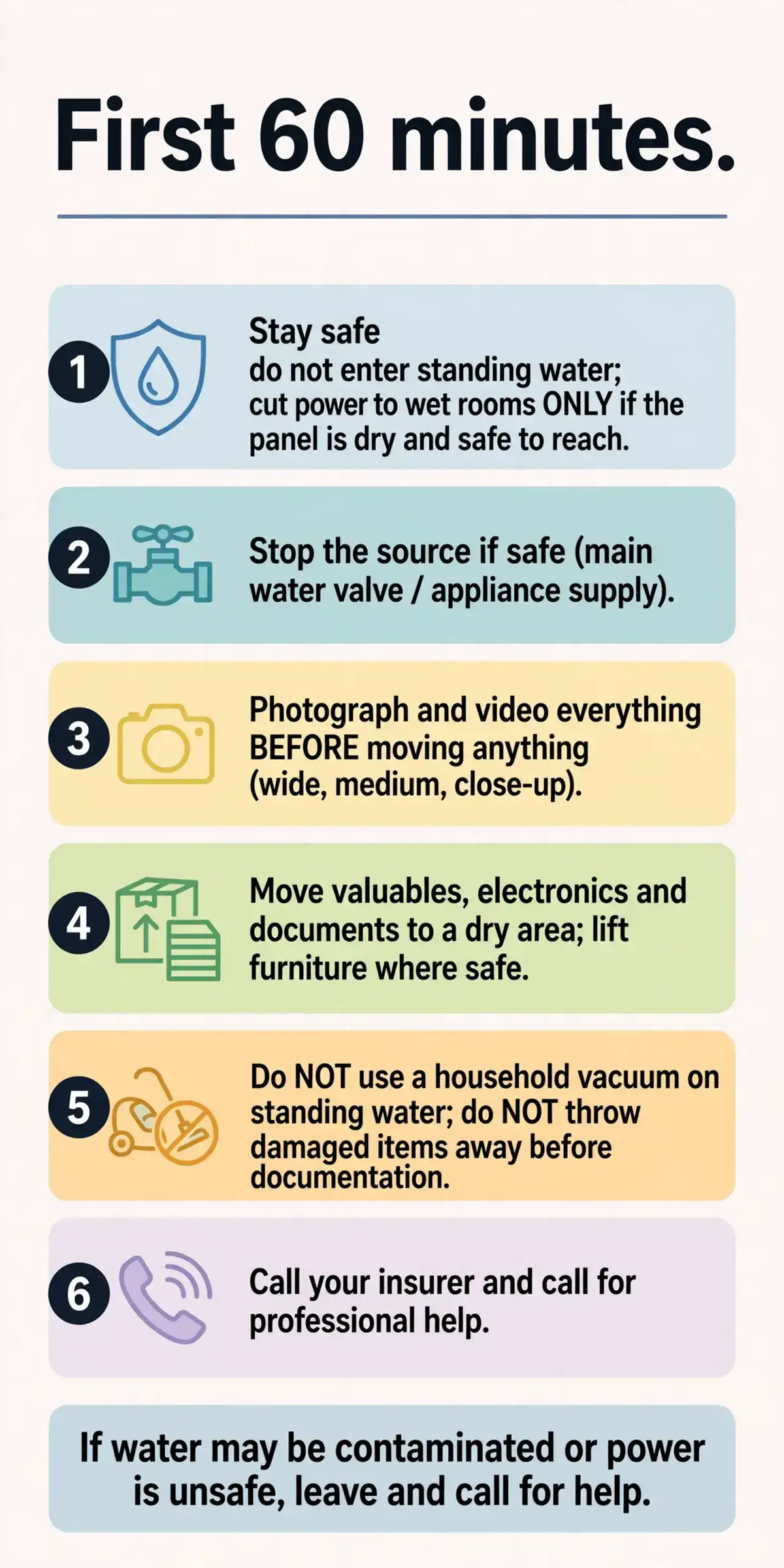
The First 60 Minutes After Water Damage in Wichita, KS
In the first hour, do three things in this order: get safe, stop the water if you can do it safely, and take pictures. Then call our team and your insurer. Keep away from electricity near water, and leave the house and call 911 or your utility if you smell gas or see sparks.
24/7 — call any time • Serving 27 Wichita ZIP codes • Local Wichita water damage team
Who This Page Is For
This page is for anyone in the Wichita area whose home just took on water. If water is in the house now, the number on this page is for active water damage in one of the Wichita ZIP codes listed near the bottom. If anyone is hurt, or the water is rising fast, call 911 first. For immediate danger, call 911 — we are a restoration team, not an emergency service.
Who We Are
ICT Water Pros is a Wichita water damage restoration company. Our team responds, inspects and does the work. When you call the number on this page, you reach our own team. Read How It Works.
Why the First Hour Matters
Water moves. It runs into carpet pad, up the bottom of the sheet rock and into the space under the floor. The sooner it stops and the sooner it is removed, the smaller the wet area. After 24 to 48 hours the job changes: if wet materials are not dried in that time, assume mold growth (S9). You do not need to know the cause or the category to start. Our team sorts that out on site.
Mold in the First Day
Mold needs moisture. Wet materials should be dried within 24 to 48 hours; if they are not dried in that time, assume mold growth (S9). The first-hour steps below do not stop mold by themselves. Removing the water and drying the structure does. For the full picture, see mold after water damage.
Belongings in the First Hour
Move what you can reach safely: papers, photos, small items. Do not touch anything electrical while you are standing in water. Photograph your belongings before you move them, then make a written list. Do not throw anything out until it has been photographed and listed. Hard items, like glass and metal, usually clean up. Soft items, like upholstery and mattresses, are often lost if the water was flood or sewage water (Category 3) (S10).
Insurance in the First Hour
Photographs first, call second. Your insurer will ask what caused the water, because a standard homeowners policy generally covers sudden and accidental damage, such as a burst pipe, and commonly excludes gradual leaks and flood (S7). Call your insurer early, and ask what they need from you. Keep every receipt for emergency steps. Full guide: water damage insurance in Kansas.
The Checklist, Minute by Minute
General guidance. The times are a way to order the steps, not a promise about how long anything takes.
- First few minutes: get safe. Keep away from standing water if power is on. If you smell gas, see sparks, or the building feels unsafe, leave and call 911 or your utility.
- Next: stop the source if you can do it safely. For a burst pipe or leaking appliance, close the shutoff valve or the main. If the water is from rain, flood or sewage, do not try to stop it yourself.
- Power. Turn off power to the wet area only if you can reach the panel without standing in water. Otherwise call your utility or 911.
- Take pictures. Photograph and film the water, the damage, and your belongings before moving anything.
- Protect what you can. Move small items and papers out of the water if it is safe.
- Call. Call our team and your insurer. Tell them what happened, when you noticed it, and what you did.
- Write it down. The date, time, cause, steps taken and the people you spoke to.
- Wait for guidance. Do not start tearing out walls or floors before our team has measured moisture.
What Not to Throw Away Yet
Do not throw away wet carpet, sheet rock or belongings before they have been photographed and listed. The decision to dry or remove a material is made from a moisture reading, not from how it looks. Clean-water carpet is often dried while the pad is more often replaced. Wet insulation is commonly replaced.
After the First Hour
After you call, the job continues: the water is removed, the structure is measured and dried, and the readings are recorded in a dry log. Drying time depends on the materials and the moisture readings. Ask for a copy of the daily readings, and ask for final readings in writing before any wall is closed up. Choosing a company: how to choose a water damage company.
If This Happened, Do This First
| What happened | First action (general guidance) | Do not |
|---|---|---|
| Burst pipe or leaking supply line | Close the shutoff valve, then photograph the water | Stand in water near outlets |
| Water coming through a ceiling | Keep out from under it, move belongings, photograph | Poke a bulging ceiling |
| Water coming up a floor drain or toilet | Keep people and pets away, photograph from a safe spot, call | Wade in it or clean it yourself |
| Flood water or storm runoff in the house | Get to safety, leave the power off if the panel is wet, call | Walk or drive through flood water |
| Wet carpet after an appliance leak | Photograph, shut off the appliance and the water | Throw items out before listing them |
What the First Hour Costs
The checklist costs nothing but time. The restoration that follows has a cost, and we have not found published Wichita prices, so this site does not quote one. National figures from two public sources, vendor and media estimates, put the average job at about $3,455 (Bob Vila, updated May 2023) and $3,867 (PushLeads, 2026) (S8). More: water damage cost in Wichita.
Wichita Facts: How Fast It Can Happen
- 25 to 26 June 2026: the National Weather Service recorded a daily rainfall record of 5.31 inches at Wichita Eisenhower airport, with 4 to 7 inches in two to three hours across parts of the metro. Basement apartments in west Wichita were evacuated (S1).
- 3 June 2025: flash flooding hit east Wichita, including the Kellogg and Hillside ramp, Bleckley and Edgemoor. A motel reported a basement full of water (S2).
More: Wichita flood-prone areas.
Wichita ZIP Codes Covered
67202, 67203, 67204, 67205, 67206, 67207, 67208, 67209, 67210, 67211, 67212, 67213, 67214, 67215, 67216, 67217, 67218, 67219, 67220, 67223, 67226, 67227, 67228, 67230, 67232, 67235, 67260
Coverage outside these ZIP codes is not confirmed. Surrounding towns may not be included.
How a Call Works
Call (316) 205-2900 and tell our team your name, ZIP code and problem type. You talk to our own team about what happened and decide whether to hire us. Calling is free; you only pay for work you agree to. After hours, call and leave a message and our team will call you back — no instant-dispatch promise is made.p>
How This Page Was Made
Statistics on this page are tied to the sources listed at the bottom. The page shows a last reviewed date. Method details are on Sources and Methodology. This site does not publish customer reviews or job counts it cannot verify. Editor: the ICT Water Pros editors.
Quick answers about the first hour
What should I do first when I find water damage?
Get safe first. Keep away from standing water if power is on, and leave if you smell gas or see sparks. Then stop the water at its source if that is safe, and photograph everything before you move it. Call our team and your insurer. This is general guidance.
Should I turn off the power after a water leak?
Only if you can reach the panel without standing in water. If you cannot, do not go near it — call your utility or 911 instead. Never touch outlets, cords or appliances while standing in water. This is general guidance, not an electrician’s instruction.
What should I photograph before cleaning up?
The water and its source, every wet room, the damaged walls, floors and ceilings, and your belongings, before anything is moved. Film a slow walk through each room too. Write down the date and time you noticed the damage and what you did.
How fast does mold grow after water damage?
Wet materials should be dried within 24 to 48 hours; if they are not dried in that time, assume mold growth (S9). Removing the water and drying the structure within that window is the main prevention step.
Can I clean up water damage myself?
You can handle a small spill of clean water on a hard floor that you find fast and dry within a day. Call our team for anything larger, water in walls or under floors, anything that sat longer than 24 to 48 hours (S9), or any flood or sewage water (S10).
Who should I call first after water damage?
If anyone is hurt or there is gas, sparks or rising water, call 911 or your utility first. Otherwise, photograph the damage, then call our team and your insurer. Keep the list of who you called and when.
Sources
- S1: National Weather Service Wichita, 25 to 26 June 2026 event page. https://www.weather.gov/ict/event_20260625
- S2: National Weather Service Wichita, 3 June 2025 event page. https://www.weather.gov/index.php/ict/event_20250603
- S7: Kansas Insurance Department, storm and flood consumer page. https://www.insurance.kansas.gov/consumers/storm-and-flood
- S8: National restoration cost benchmarks, 2026 (vendor and media estimates). https://www.bobvila.com/articles/water-damage-restoration-cost/ and https://pushleads.com/restoration-company-seo/water-damage-restoration-cost/
- S9: CDC and EPA mold guidance (timing and cleanup thresholds). https://www.epa.gov/mold/brief-guide-mold-moisture-and-your-home and https://www.cdc.gov/mold-health/media/Homeowners_and_Renters_Guide.pdf
- S10: ANSI/IICRC S500 (categories, classes, drying). https://iicrc.org/s500/ Note: the official text for this standard has not been obtained; the statements here rest on the secondary sources listed.
Last reviewed: 2026-10-25
ICT Water Pros — Wichita, KS — Call (316) 205-2900 — Open 24/7