
DIY or Professional Water Damage Help?
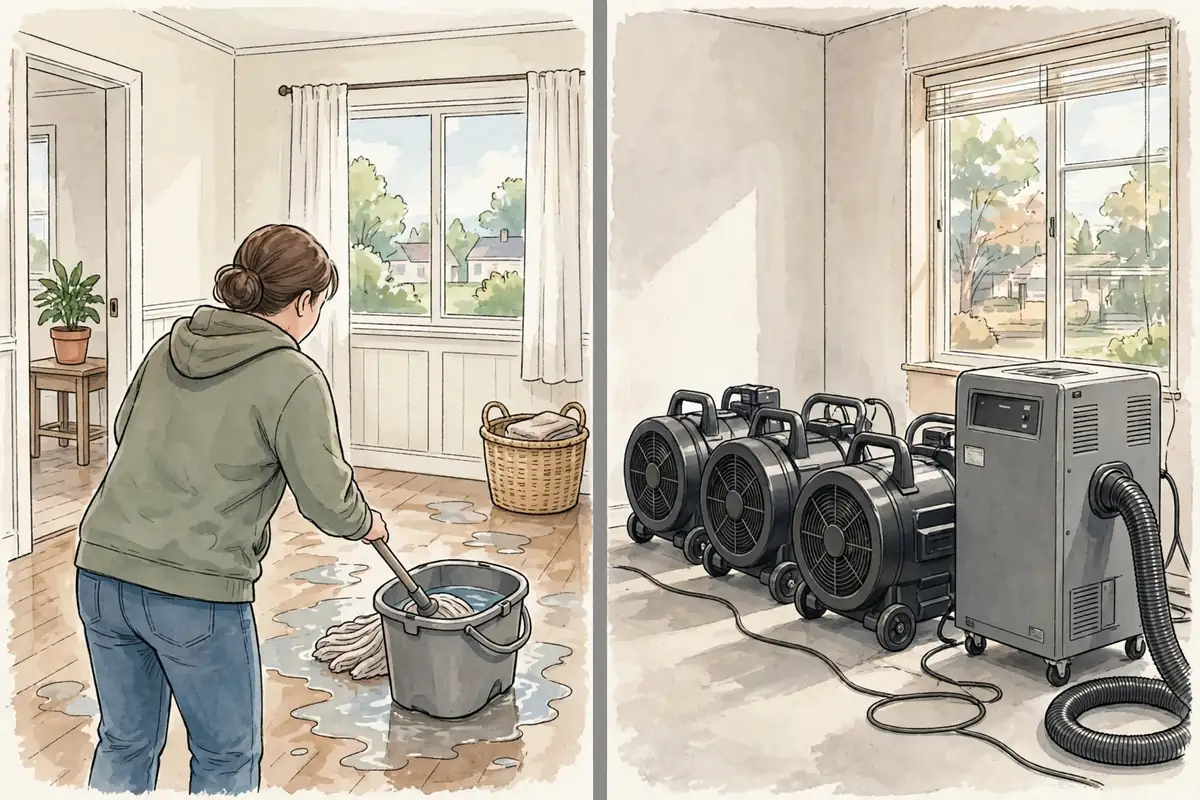
DIY or professional water damage help depends on the water and where it went. A small clean-water spill on a hard floor that you mop and dry at once can be a DIY job. Water in sheet rock, under flooring, in a wall cavity, or any gray or black water calls for our team.
24/7 — call any time • Serving 27 Wichita ZIP codes • Local Wichita water damage team
When is DIY fine for a small water spill?
DIY is fine when the job is small, clean, and fully visible. Think of a glass of water tipped over, a pet bowl spill, or a small splash from a sink that stays on tile or sealed flooring. You can mop it up, dry the surface with towels, run a fan, and check the next day that the floor and nearby baseboards feel dry and look normal.
The key test is simple: can you see all of the water, do you know it is clean, and can you dry it fully at once? If the answer to all three is yes, a careful DIY cleanup is reasonable. Keep the area dry, watch for a stain or smell over the next few days, and do not cover the spot with a rug until you are sure it is dry underneath.
Even a small DIY job deserves a note. Write down the date, what spilled, and what you did, and take a quick photo if the spill reached a wall or cabinet base. That record costs a minute and helps if a stain shows up later and you need to explain when the water first appeared.
When should I call a professional instead of doing it myself?
Call our team when water has reached sheet rock, carpet and padding, wood flooring, or a wall cavity, even if the puddle on top looks small. Water wicks upward into sheet rock and sideways under flooring, so the wet area under the surface is often larger than the wet area you can see. Our team uses a moisture meter to find that hidden spread before it turns into mold or a warped floor.
Also call our team when you do not know the source, when water keeps coming back, when a ceiling stain is spreading, or when the leak involves a hot water tank, a burst pipe, or a drain. Those jobs need the source stopped, the spread measured, and the materials checked, and guessing at any of those steps can leave wet material sealed behind a repair.
In June 2026, Wichita saw how fast outside water can turn a home job into a professional job. KSN TV reported up to 6 inches of rain overnight across the Wichita area, and Wichita Fire ran 180 calls in 10 hours, with 60 percent water-related. Flood water from outside is not a DIY cleanup, and neither is water you cannot identify. When in doubt, a moisture check beats a guess.
Why is sewage or flood water never a DIY job?
Sewage and flood water are Category 3 black water, which means they can carry harmful bacteria, chemicals, and debris. Mopping, vacuuming, or drying that water yourself spreads it further and puts you in contact with it. Porous materials soaked by black water often need removal by our team with the right cleaning and safety steps, not a home dry-out.
The same rule holds for water that has sat long enough to change category. Clean water that runs across a dirty floor or sits for a day or more may no longer be clean, and CDC and EPA guidance says mold can start within 24 to 48 hours on wet materials. If you find water late, or you are unsure how long it sat, do not treat it as a simple spill.
Keep children and pets out of gray or black water, do not use a household vacuum on it, and do not throw soaked items into a regular trash pile without advice. Our team can tell you what to keep for photos and insurance, what to remove, and how the area should be cleaned. That advice is worth getting before you touch the water at all.
What does a professional do that DIY cannot?
Our team starts with measurement, not mopping. Moisture meters and, where needed, checks inside wall cavities show how far water spread, which materials are wet, and which are dry. That map shapes the whole job: what to dry, what to remove, and how long drying should run before repairs start.
Our team also brings drying equipment sized to the wet area, such as air movers and dehumidifiers, and keeps readings over days until materials reach a dry range. A household fan can dry a surface, but it cannot pull water from inside sheet rock or concrete at the same pace, and it gives you no reading to prove the job is done.
ICT Water Pros is a Wichita water damage restoration company. Our team responds, inspects and does the work. Calling is free; you pay only for work you agree to.
The National Weather Service Wichita office recorded a flood event on 25 to 26 June 2026, and an earlier event on 3 June 2025. Those events are a reminder that Wichita homes face both indoor leaks and outside flood water, and the second kind always needs a professional assessment.
How do I decide between DIY and a professional?
Run through four questions before you pick up a mop. Is the water clean and do you know the source? Is all of it visible on a hard surface? Can you dry it fully right now? Is there any sheet rock, carpet, flooring, or wall cavity involved? If any answer is no or unsure, call our team for an assessment rather than starting a DIY cleanup.
Cost is a fair question, and an itemized quote is the honest way to answer it for your home. National figures are background only and are not Wichita prices: Bob Vila reported in May 2023 an average job of about $3,455 nationally, and PushLeads in 2026 put a national figure near $3,867. No Wichita prices have been published that could be found, so do not use a national average as a quote, and do not let a guessed price push you into a DIY job on gray or black water.
A common DIY trap is buying gear before you know the spread. That is the heart of the DIY or professional water damage choice. Home dehumidifiers, fans, and moisture gadgets can help a surface spill, but they do not map hidden water, and running them in a closed room with wet sheet rock can give a false sense of progress. If you already own a fan and a dehumidifier, use them for a small clean spill you can see fully, and stop if a smell, stain, or soft spot shows up. For anything larger, spend the call first and the money second: an assessment from our team tells you which rooms need equipment, how long it should run, and whether material must come out. That order saves more than a new machine bought in a hurry, because it stops you drying the wrong area while the wet area behind a wall stays wet.
If you do call, have your notes ready: when you found the water, where it came from if you know, which rooms it reached, and photos with dates. That short brief helps our team judge the job fast and keeps your record straight for any insurer conversation later. A clear brief also stops a small job from growing while everyone works out what happened.
What should I do right now if I am unsure?
If you are unsure, treat the job as a professional job until our team says otherwise. Stay out of water you cannot identify, do not touch outlets or appliances in standing water, and shut off the water at a safe valve if the source is a burst pipe or a hot water tank and you can reach it without wading. Take photos from a safe spot and write down the time you found the water.
Then call for an assessment. You can reach ICT Water Pros at (316) 205-2900. Calling is free, and you only pay for work you agree to, so an assessment question costs you nothing to ask.
Do not start pulling up flooring, cutting sheet rock, or painting over a stain while you wait. Those steps can hide wet material, spread dirty water, or make an assessment harder. Keep the area as you found it, keep people and pets out of any suspect water, and let the moisture check decide whether the job is a simple dry-out or a full professional cleanup.
DIY or professional: a plain decision guide
| Situation | DIY or pro? | Why | First step |
|---|---|---|---|
| Small clean spill on tile, mopped at once | DIY can be fine | All water visible, clean, dried at once | Mop, towel dry, fan, check next day |
| Spill that reached carpet or padding | Call our team | Padding holds hidden water | Get moisture readings before you decide |
| Water in sheet rock or a wall cavity | Call our team | Hidden spread and mold risk in 24-48 hours | Do not cut or paint over it, get a check |
| Gray water from a washer or dishwasher | Call our team | Dirty water needs professional cleaning | Keep people out, note the start time |
| Sewage backup or flood water | Call our team, never DIY | Category 3 black water, health risk | Stay out, call our team, do not mop it |
| Leak found days later, source unclear | Call our team | Category may have worsened over time | Photograph, note dates, get an assessment |
Frequently Asked Questions
Can I use a wet vacuum on a small clean spill?
Yes, for a small clean spill on a hard floor, a wet vacuum can help. Do not use a household vacuum on gray or black water, sewage, or flood water, and do not use it on water near outlets or appliances.
Is it safe to dry carpet with fans after a clean leak?
Sometimes, but only if the water stayed on the surface and the carpet and padding dry fully. If padding stayed wet, water reached sheet rock, or a smell starts, get a moisture check from our team rather than relying on fans alone.
Should I remove wet sheet rock myself?
No, do not cut or remove sheet rock yourself as a first step. Hidden water, wiring, and mold risk make this an assessment-first job, so our team can map the wet area and say what must come out.
What if I already mopped up gray water before reading this?
Do not panic, but get a check from our team now. Tell us what the water was, when it happened, and what you cleaned, so we can check the area, clean it properly, and confirm whether materials need removal.
Does calling ICT Water Pros mean I have hired a contractor?
No, it does not. Calling ICT Water Pros means you have asked our team for an assessment. Calling is free; you only pay for work you agree to, and you can ask questions before you agree to any work.
Sources
- KSN TV — June 2026 Wichita flash flooding. https://www.ksn.com/weather/weather-stories/heavy-rain-leads-to-flash-flood-emergency-in-wichita-several-cars-submerged/ — Source for up to 6 inches of rain overnight and Wichita Fire call figures.
- NWS Wichita — 25-26 June 2026 event. https://www.weather.gov/ict/event_20260625 — Dated Wichita flood event.
- NWS Wichita — 3 June 2025 event. https://www.weather.gov/index.php/ict/event_20250603 — Earlier dated Wichita event.
- CDC homeowners and renters mold guide. https://www.cdc.gov/mold-health/media/Homeowners_and_Renters_Guide.pdf — Mold can start within 24-48 hours on wet materials.
- EPA mold guide. https://www.epa.gov/mold/brief-guide-mold-moisture-and-your-home — Mold and moisture guidance for homes.
- Bob Vila water damage cost, May 2023. https://www.bobvila.com/articles/water-damage-restoration-cost/ — NATIONAL benchmark only, about $3,455 average job; not a Wichita price.
- PushLeads water damage cost, 2026. https://pushleads.com/restoration-company-seo/water-damage-restoration-cost/ — NATIONAL benchmark only, about $3,867; not a Wichita price.
Service area: ICT Water Pros serves the Wichita metro across 27 ZIP codes: 67202–67220, 67223, 67226, 67227, 67228, 67230, 67232, 67235, 67260. Location line: Downtown Wichita Area · Wichita, KS 67202. No street address is claimed.
Last reviewed: 2026-10-26
Related pages: ICT Water Pros home page · how it works · water damage cost in Wichita · water categories and classes explained · how long water damage takes to dry · first 60 minutes after water damage · mold after water damage
ICT Water Pros — Wichita, KS — Call (316) 205-2900 — Open 24/7