
Water Category Checker
The water category checker on this page is a guided checklist, not an automatic diagnosis. You answer three questions about where water came from, what it looks and smells like, and how long it sat, then the table points to Category 1, 2, or 3. Our team with a meter decides the final category on site.
24/7 — call any time • Serving 27 Wichita ZIP codes • Local Wichita water damage team
What is this checker, and what can it not do?
This checker is a guided checklist you work through yourself, not a tool that diagnoses your home on its own. It does not test water, read a meter, or look inside a wall, and it cannot give a final category for one home. What it can do is help you sort your answers into Category 1, Category 2, or Category 3, so you know how to talk to our team and whether to stay out of the water. The final category is decided on site by our team with a meter, who checks the source, the materials touched, and how far water traveled. If sewage or flood water is involved at any point, stop here: stay out and do not clean it yourself, whatever the table says.
What is the first question: where did the water come from?
Where the water came from is the strongest clue, so answer it first and be as plain as you can. Clean water from a supply line, a broken pipe feeding a sink, or a hot water tank leak starts as Category 1, because it came from a clean source. Water from a washer drain, a dishwasher drain, a shower drain, or a toilet overflow without waste starts closer to Category 2, because it carries dirt and waste from use. Water from sewage, a toilet backup with waste, a sewer line, or flood water from outside is Category 3, because it carries waste and germs. In June 2026, KSN TV reported up to 6 inches of rain overnight across the Wichita area, and flood water from that kind of event is Category 3 even if it looks clear in a photo. If you are unsure of the source, say so, and do not guess clean.
What does the water look and smell like?
Look and smell are your second check, and they can move a category up even when the source seemed mild. Clear, clean-smelling water fits Category 1 at first glance. Cloudy water, water with soap, food, or dirt in it, or water with a stale or sour smell fits Category 2 more often, because it shows the water picked up waste on its way. Dark water, water with waste in it, or water with a strong sewage smell fits Category 3, and you should stay out of it. Color alone does not decide: flood water can look brown from mud or look fairly clear and still be Category 3, because it passed over ground, roads, and drains. The National Weather Service Wichita office recorded a major flood event on 25-26 June 2026, and during that stretch Wichita Fire ran 180 calls in 10 hours, with 60 percent water-related, a sign of how much flood water moved through homes and streets. Note what you see and smell, but do not wade in to check closer.
How long has the water sat, and why does time change the category?
Time matters because clean water does not stay clean. Water that sat for hours in carpet, sheet rock, or a wall cavity picks up dirt, dust, and germs from the materials it touches, and a Category 1 start can move toward Category 2 as hours pass. Water that sat for days, especially in warm rooms, is treated with more care, because mold can start within 24-48 hours on wet materials, per CDC and EPA guidance. That time rule does not turn a small clean spill into sewage, but it does mean our team will treat an old leak with more care than a fresh one, and may remove porous material that a fresh spill would have left dryable. Write down when you first found the water and, if you know it, when it may have started, because that gap is one of the first facts our team asks for. If water sat long enough that you cannot say when it started, treat that unknown as a reason for an on-site check, not a reason to wait longer. A slow leak behind a hot water tank is a common Wichita example, because it can run for weeks under a floor before anyone sees a stain, and by then the category question is harder than it was on day one. Our team will still ask the same three questions, but the time answer may push us to test more rooms, since water can travel along framing and under flooring far from the source. That wider check is normal, not a sign that the whole house is ruined, and it is why writing down the earliest date you noticed a smell, a stain, or a soft spot helps even when you missed the start.
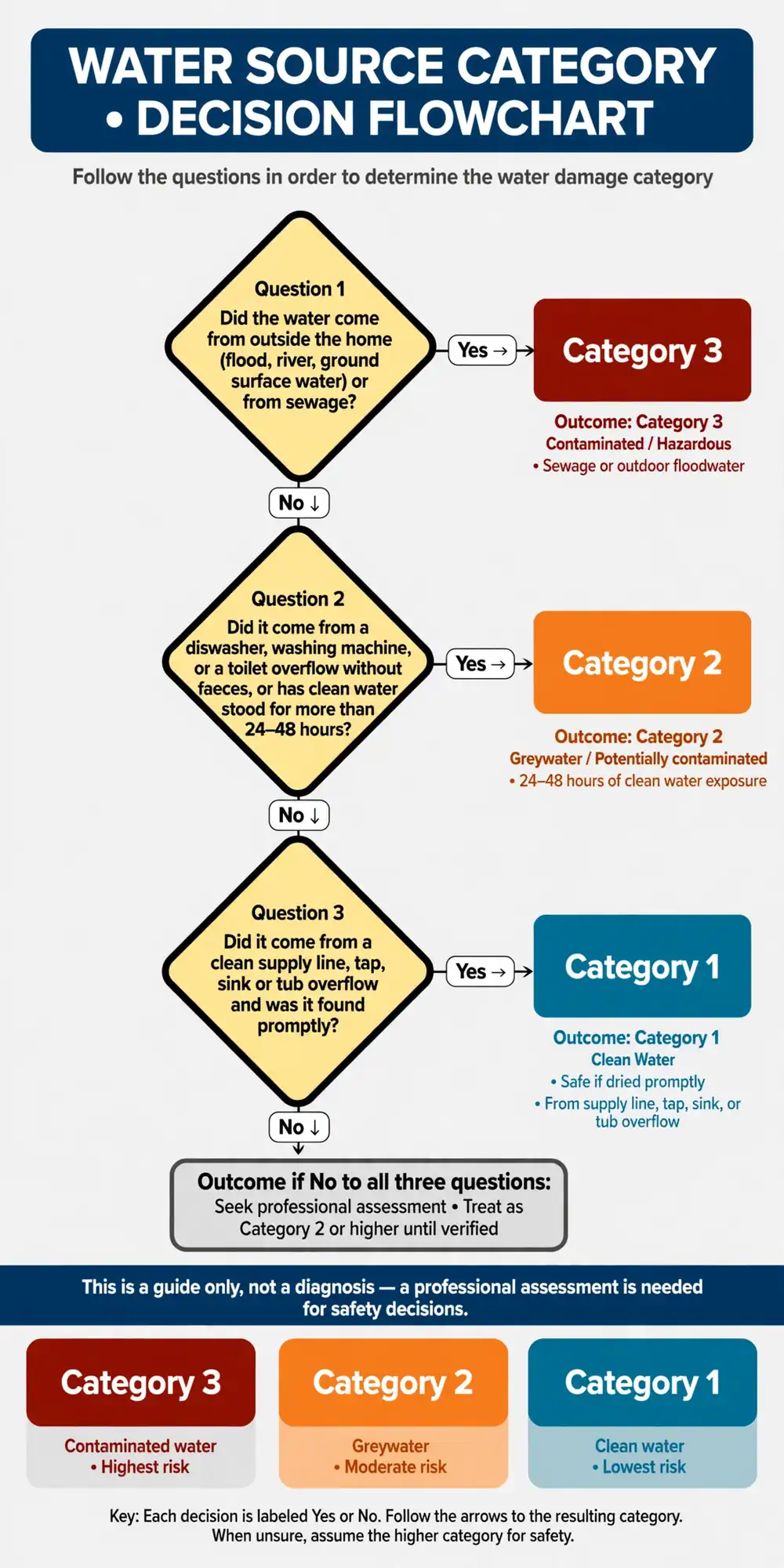
How do I use the water category checker step by step?
Work through the steps in order, write your three answers down, and then match them to the table. Do not skip the source question, because it carries the most weight, and do not clean sewage or flood water yourself while you work through the list. If any answer points to Category 3, that answer wins over a milder answer elsewhere: for example, clean-looking water that came from a sewer line is still Category 3. After you match your answers, call our team through (316) 205-2900 and share your three answers so the first visit starts from facts, not guesses. For homes in the Wichita metro served from Downtown Wichita Area · Wichita, KS 67202, that call reaches our own team, and this site sets no response time.
- Step 1: Find where the water came from, and stop it if you can do it safely.
- Step 2: Look at the water and note its color, cloudiness, and smell.
- Step 3: Note how long the water has sat, in hours or days.
- Step 4: Match your three answers to the table below to find the likely category.
- Step 5: If the table points to sewage or flood water, stay out and do not clean it yourself.
- Step 6: Call our team for an on-site check, and share your three answers with us.
What do I do after the checker points to a category?
If the checker points to Category 1, stop the source if you can do it safely, take photos, move dry items out of the wet area, and call our team for drying and meter checks. If it points to Category 2, keep people and pets out of the wet area where you can, do not use fans to blow that water into dry rooms, and call our team, because porous material soaked in gray water may need removal. If it points to Category 3, stay out, do not clean it yourself, keep children and pets away, and call our team for advice on next steps. On 3 June 2025 the National Weather Service Wichita office also recorded a flood event, which shows Wichita homes face flood water in more than one year. No Wichita prices have been published that could be found, so any dollar figures linked from this site are NATIONAL benchmarks only, not Wichita prices. Keep your three answers and your photos for our team and for your insurer.
| Your answers | Likely category | What it means | What to do |
|---|---|---|---|
| Clean supply line, clear water, found fast | Category 1 | Clean source water | Stop source, call for drying check |
| Clean source, but sat for days | Category 2 (or higher) | Water picked up dirt over time | Call our team; do not assume clean |
| Washer or dishwasher drain, cloudy water | Category 2 | Gray water with dirt and waste | Keep out, call our team |
| Sewage, toilet waste, or sewer backup | Category 3 | Black water with waste and germs | Stay out, do not clean it yourself |
| Flood water from outside, any look | Category 3 | Flood water with waste and germs | Stay out, do not clean it yourself |
Frequently Asked Questions
Can this checker tell me my final water category?
No, this checker gives a likely category from your answers only. The final category is decided on site by our team with a meter.
What if my answers point to two different categories?
Use the higher, more serious category. For example, clear-looking water from a sewer line is still Category 3, because the source decides over the look.
Does clean water stay Category 1 if it sits for days?
Not always, because water picks up dirt and germs from materials it touches over time. Our team treats an old leak with more care than a fresh spill.
Can I clean flood water myself if I wear boots?
No, stay out of flood water and do not clean it yourself. Flood water is treated as Category 3, and boots do not change that advice.
Who do I call in Wichita after using the checker?
Call (316) 205-2900 — that reaches ICT Water Pros and our own team. Calling is free, and you only pay for work you agree to.
Sources
- EPA: A Brief Guide to Mold, Moisture and Your Home. https://www.epa.gov/mold/brief-guide-mold-moisture-and-your-home — Mold can start within 24-48 hours on wet materials.
- IICRC S500 (official text not obtained). https://iicrc.org/s500/ — Standard for water damage categories; official S500 text was not obtained, so category wording here follows plain secondary-source summaries.
- National Weather Service Wichita: June 2026 event. https://www.weather.gov/ict/event_20260625 — NWS Wichita 25-26 June 2026 event.
- KSN TV: Heavy rain leads to flash flood emergency in Wichita. https://www.ksn.com/weather/weather-stories/heavy-rain-leads-to-flash-flood-emergency-in-wichita-several-cars-submerged/ — June 2026: up to 6 inches of rain overnight across the Wichita area.
Service area: ICT Water Pros serves the Wichita metro across 27 ZIP codes: 67202–67220, 67223, 67226, 67227, 67228, 67230, 67232, 67235, 67260. Location line: Downtown Wichita Area · Wichita, KS 67202. No street address is claimed.
Last reviewed: 2026-10-26
Related pages: Home · How it works · Water damage cost in Wichita · First 60 minutes after water damage · Flood cleanup
ICT Water Pros — Wichita, KS — Call (316) 205-2900 — Open 24/7