
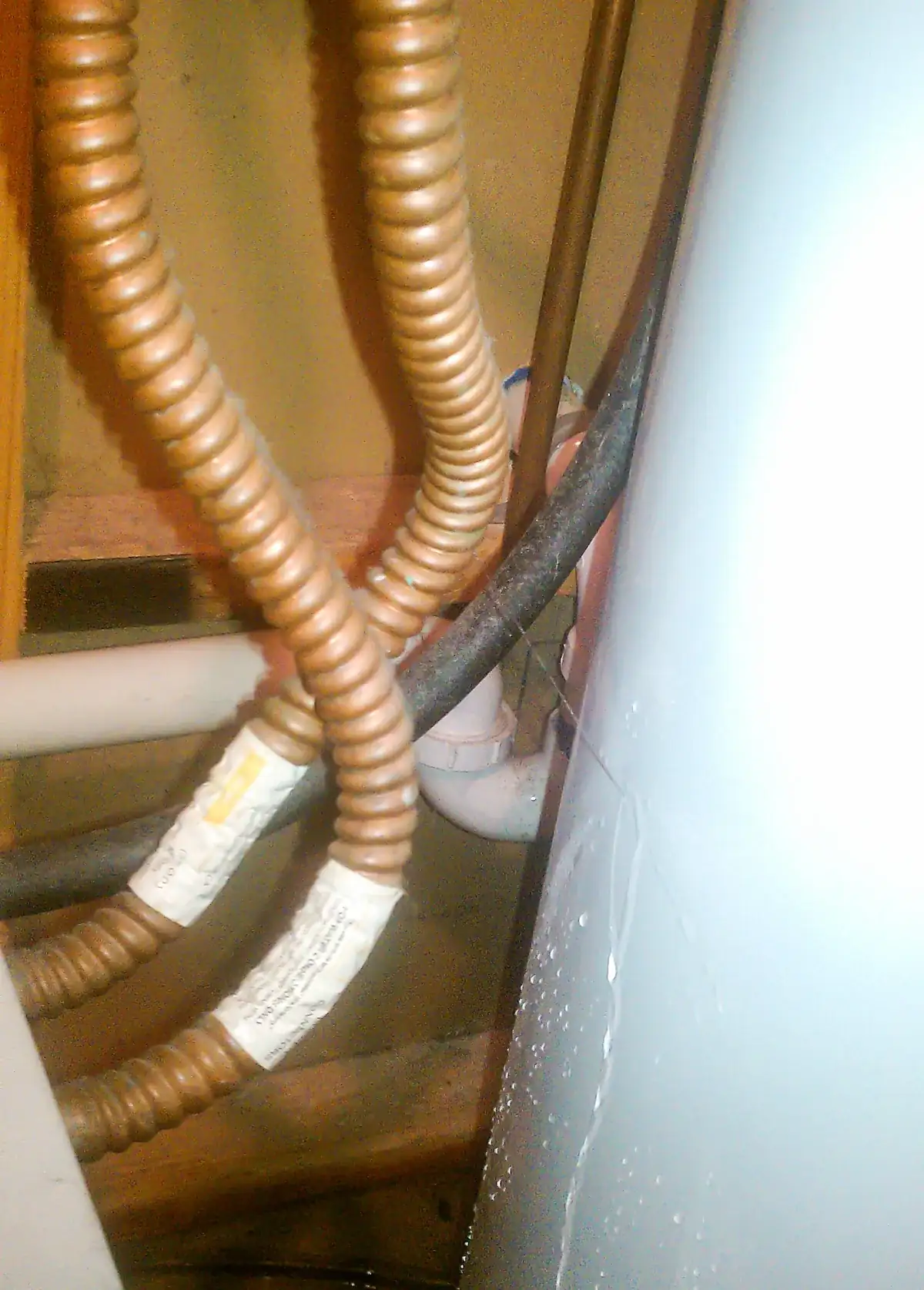
Appliance & Hot Water Tank Leak
If a washer, dishwasher, or hot water tank leaks, shut off the water first if you can reach it without stepping in water, and switch off power near wet outlets only under the same rule. Move dry items away, then call our team at ICT Water Pros.
24/7 — call any time • Serving 27 Wichita ZIP codes • Local Wichita water damage team
What should I shut off first when a hot water tank leaks?
Start with the water. If you can reach the shut-off for the hot water tank or the main house shut-off without stepping in water, turn it off to stop more water from feeding the leak. If the shut-off is in standing water, or you would have to step through water to reach it, do not go in. Leave it and call for help instead, because water and electricity together are not a risk worth taking for a valve. Power comes second, and only under the same rule. If an outlet, power strip, or appliance plug near the leak is wet, switch off power only if you can reach the switch or breaker without stepping in water and without touching anything wet. If you cannot do that safely, stay out of the room and wait for our team. Once the water is stopped and the power question is settled, move dry items, rugs, and boxes away from the wet area, and take photos of the leak and the rooms affected for your own records. You can call ICT Water Pros at (316) 205-2900. Our location line is Downtown Wichita Area · Wichita, KS 67202.
Why do hot water tank leaks show up after time away?
Many homeowners first notice a hot water tank leak after a trip, a weekend away, or a stretch when the house was quiet. A slow drip from a tank, a fitting, or a supply line can run for hours without anyone hearing it or seeing a puddle, because no one is walking past the utility room or the garage. By the time you come home, water may have spread under flooring, into baseboards, and into the wall behind the tank. The leak did not need to be large to cause that spread. It only needed time.
Time away also means the signs that would normally catch your eye are missed. A small damp patch on a garage floor, a musty smell near a closet, or a water heater pan with water in it can sit unnoticed for days. When you return, check the area around the hot water tank, the washer, and the dishwasher before you unpack or run a load of laundry. If the floor is wet, the wall is damp, or the tank area smells musty, treat it as an active leak until our team has looked at it, even if the drip itself looks small.
What happens when a washer or dishwasher overflows?
A washer or dishwasher overflow is usually gray water, which means water that has passed through a machine and carries soap, food, or dirt with it. It is not the same as clean supply water, and it should not be treated as harmless just because it came from a household machine. Gray water can soak into flooring, subfloor, and the wall behind the machine, and it can leave a smell behind even after the visible water is mopped up. That is why drying matters, not just mopping the surface you can see.
Overflows often start with a hose, a drain, or a door seal rather than with the machine itself. A washer drain hose can slip, a dishwasher drain can back up, or a door seal can fail during a cycle and let water run across a kitchen or laundry floor. If a cycle is running and water is spreading, stop the machine if you can do so without stepping in water, shut off the water supply to the machine, and move dry items away. Then call our team to look at how far the water travelled, including under the machine and into nearby cabinets or walls.
How do supply lines cause appliance leaks?
Every appliance that uses water has a supply line, and that line is often the weak point. A supply line can loosen at a fitting, crack with age, or rub against a wall or floor until it wears through. The leak that follows can be a slow drip or a steady stream, and because supply lines sit behind machines and tanks, the water often runs along a wall or under flooring before anyone sees it. Checking the lines behind a washer, dishwasher, and hot water tank is one of the simplest ways to catch a problem early, and it costs nothing but a few minutes.
When you check a supply line, look for dampness at the fittings, rust or mineral build-up, a hose that feels stiff or swollen, and any puddle or stain on the floor beneath it. Do not force a stiff fitting or over-tighten a connection you are unsure about, because that can make a small leak worse. If a line looks worn or is already leaking, shut off the water to that appliance if you can reach the valve without stepping in water, and ask our team to look at it.
What should I do about wet floors, walls, and nearby rooms?
Water from an appliance leak rarely stays in one room. It follows gravity and the gaps in flooring, so it can run under a wall into the next room, down through a floor into a ceiling below, or along a baseboard into a closet. After you stop the water, check the rooms next to the leak and the room below it, if there is one. Look for damp carpet, buckling floor boards, paint that is bubbling, and a musty smell that was not there before. Those signs tell our team where the water travelled, even when the surface looks dry.
Wet materials can start to grow mold within 24 to 48 hours, according to CDC and EPA guidance, so the first days after a leak matter. Our team can check moisture in walls and floors, work out which materials can be dried and which need to come out, and set up drying for the rooms affected. Wichita homeowners saw the same urgency after the June 2026 storm, when KSN reported up to 6 inches of rain overnight and more than 100 flooded-vehicle calls to 911, a reminder of how fast water problems grow when they are left alone.
How It Works When You Call Our Team
When you call ICT Water Pros at (316) 205-2900, our own team takes your job: we visit, check the leak, and talk through the drying and repair steps with you. You only pay for work you agree to, and the price of any job is agreed with you before work starts. ICT Water Pros serves the Wichita metro, including ZIP codes 67202-67220, 67223, 67226, 67227, 67228, 67230, 67232, 67235, and 67260. It helps to be ready with a few facts when you call: which appliance leaked, when you first noticed it, whether the water is still running, and which rooms feel wet. No Wichita prices have been published that could be found, so this page does not quote a local price. National benchmarks, such as about $3,455 from Bob Vila in May 2023 and about $3,867 from PushLeads in 2026, are NATIONAL figures only, and per-square-foot NATIONAL ranges run about $3 to $4 for cleaner water, $4 to $7 for gray water, and $7 to $7.50 for the dirtiest category. Your own job will depend on the damage found.
What will our team check first?
Our team will usually start at the source: the hot water tank, the washer or dishwasher, and the supply lines feeding them. Finding the source matters because drying a floor without stopping the leak only buys a short pause before the water returns. Our team will also check how far the water spread, including under machines, behind baseboards, and in the room below, and will look for moisture in walls and floors that you cannot see from the surface. From there, our team can talk through drying, which materials can stay, and which may need to come out, and what the next steps look like for your home. If the leak followed a Wichita storm, the same visit may also cover roof or basement water that arrived at the same time. The National Weather Service in Wichita recorded a storm event on 3 June 2025 as well as the 25-26 June 2026 event, so storm-related leaks are a recurring part of life here. Whatever the cause, the first visit is about facts: source, spread, and drying, in that order.
Checklist
- The appliance or tank that leaked, and its supply lines
- Rooms next to the leak and the room below it
- Moisture in walls, floors, and baseboards
- Whether the water is still running or already stopped
| Source | Water type | First step | Watch for |
|---|---|---|---|
| Hot water tank leak | Clean supply water in most cases | Shut off water if reachable without stepping in water | Damp wall behind the tank, wet flooring |
| Washer overflow | Gray water with soap and dirt | Stop the machine and shut off its water supply | Water under the machine and in nearby rooms |
| Dishwasher overflow | Gray water with soap and food | Stop the cycle and shut off its water supply | Water in cabinets and under kitchen flooring |
| Supply line failure | Clean or gray water, by appliance | Shut off water to that appliance | Damp fittings, stiff or swollen hoses |
| Leak found after time away | Depends on the source | Check rooms next to and below the leak | Musty smell, damp baseboards, buckling floors |
Frequently Asked Questions
Should I turn off power if my hot water tank is leaking?
Only if you can do so without stepping in water and without touching anything wet. Switch off power near wet outlets under that rule only. If you cannot reach the switch safely, stay out of the room and call our team.
Is washer water safe to mop up myself?
Washer and dishwasher water is usually gray water, which carries soap and dirt. Mopping the surface helps, but it does not dry what soaked into flooring or walls. Our team can check moisture you cannot see and set up drying.
My tank leaked while I was away. Is a small drip urgent?
Yes, treat it as urgent until our team has looked at it. A slow drip running for days can spread under flooring and into walls. Wet materials can start to grow mold within 24 to 48 hours, according to CDC and EPA guidance.
Does ICT Water Pros fix hot water tanks?
No — we do water damage cleanup and drying, not appliance repair. Our team checks the damage the leak caused, dries the rooms, and talks through next steps; a plumber or appliance technician handles the tank repair itself.
How much does an appliance leak job cost in Wichita?
No Wichita prices have been published that could be found, so no local price is quoted here. National benchmarks of about $3,455 (Bob Vila, May 2023) and about $3,867 (PushLeads, 2026) are NATIONAL figures only, and your price depends on the damage found; you get an itemized quote before work starts.
Sources
- EPA – Brief guide to mold, moisture and your home. https://www.epa.gov/mold/brief-guide-mold-moisture-and-your-home — EPA guidance on mold growth on wet materials.
- CDC – Homeowners and renters guide to mold. https://www.cdc.gov/mold-health/media/Homeowners_and_Renters_Guide.pdf — CDC guidance on mold in homes after water damage.
- KSN – Heavy rain leads to flash flood emergency in Wichita. https://www.ksn.com/weather/weather-stories/heavy-rain-leads-to-flash-flood-emergency-in-wichita-several-cars-submerged/ — KSN report on the June 2026 Wichita flooding, including rainfall and emergency calls.
- National Weather Service Wichita – 25-26 June 2026 event. https://www.weather.gov/ict/event_20260625 — NWS Wichita event summary for the June 2026 storm.
- National Weather Service Wichita – 3 June 2025 event. https://www.weather.gov/index.php/ict/event_20250603 — NWS Wichita event summary for the June 2025 event.
- Bob Vila – Water damage restoration cost (May 2023). https://www.bobvila.com/articles/water-damage-restoration-cost/ — NATIONAL benchmark only, about $3,455 on average; not a Wichita price.
- PushLeads – Water damage restoration cost (2026). https://pushleads.com/restoration-company-seo/water-damage-restoration-cost/ — NATIONAL benchmark only, about $3,867 on average; not a Wichita price.
Last reviewed: 2026-10-26
Service area: ICT Water Pros serves the Wichita metro across 27 ZIP codes: 67202–67220, 67223, 67226, 67227, 67228, 67230, 67232, 67235, 67260. Location line: Downtown Wichita Area · Wichita, KS 67202. No street address is claimed.
Related pages: ICT Water Pros home • How it works • Water damage cost in Wichita • First 60 minutes after water damage • Mold after water damage • Burst pipe water damage • Emergency water extraction
ICT Water Pros — Wichita, KS — Call (316) 205-2900 — Open 24/7