
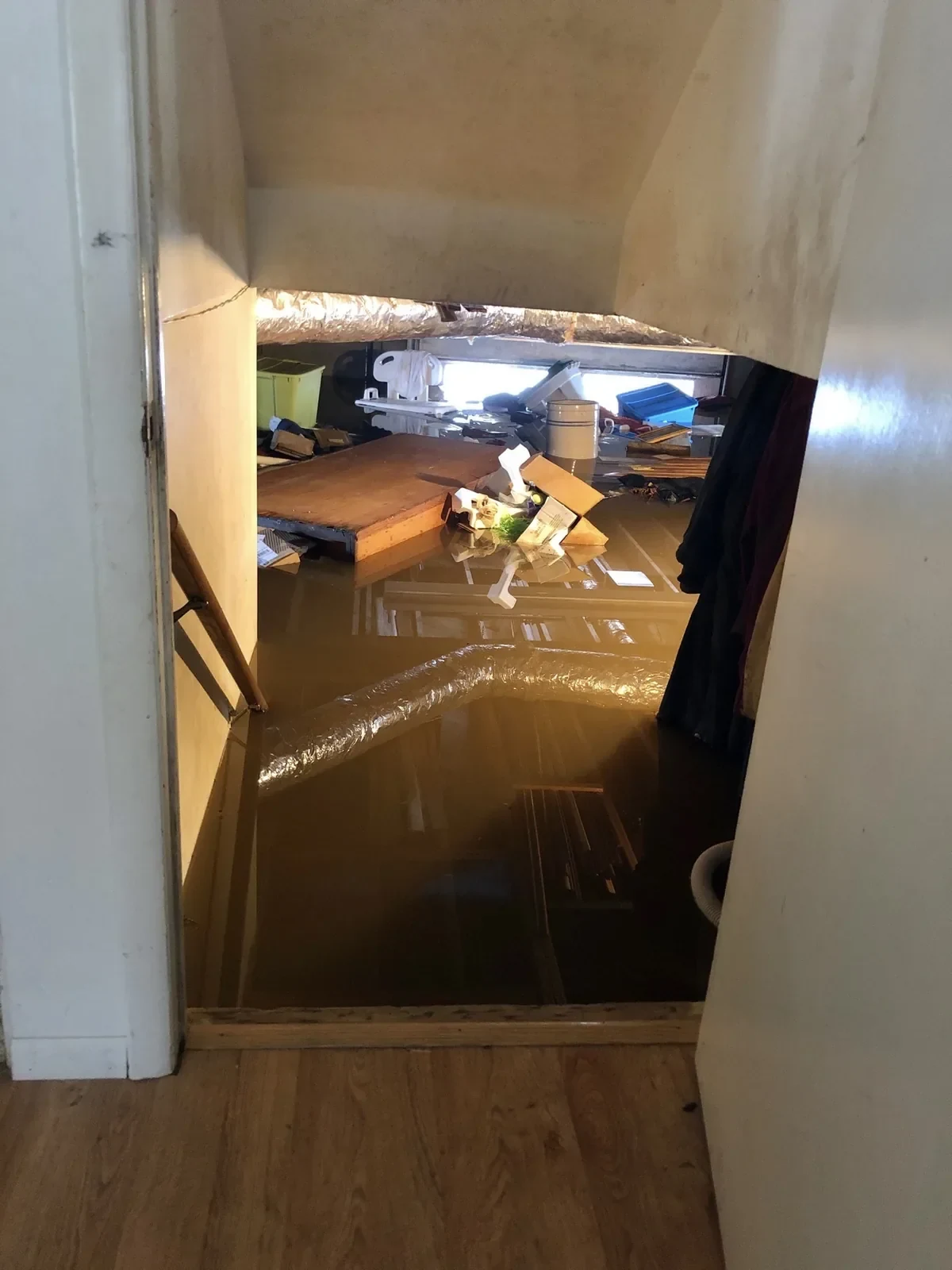
Sump Pump Failure & Basement Flooding
Sump pump failure lets a basement fill fast, because the pump is often the only thing moving water ou
24/7 — call any time • Serving 27 Wichita ZIP codes • Local Wichita water damage team
Why does a sump pump fail during a heavy storm?
Sump pump failure basement flooding starts for a few plain reasons, and a heavy storm can bring several at once. The pump can lose power, the float switch can stick, the discharge line can freeze, clog, or discharge too close to the house so water runs straight back, or the pump can simply be overwhelmed by inflow that is faster than it can move. A pump that worked fine in light rain can fail in a storm that drops inches of rain in a few hours. Wichita’s June 2026 flash flood shows how fast inflow can grow. KSN TV reported up to 6 inches of rain overnight across the Wichita area, 911 took more than 100 flooded-vehicle calls, and Wichita Fire ran 180 calls in 10 hours, with 60 percent water-related. The National Weather Service Wichita page for the 25-26 June 2026 event is the official record. In that kind of rain, a sump pit can fill in minutes, and a pump that is old, undersized for the pit, or not tested in months may not keep up. Testing matters more than age alone. Our team can test the pump, check the float, check the discharge line, and tell you whether the pump failed or was overwhelmed. Keep a note of when the pump was last tested, when it last ran, and whether it has ever failed before, because that history helps our team judge what needs fixing first.
ICT Water Pros is a Wichita water damage restoration company. Our team responds, inspects and does the work. Calling is free; you pay only for work you agree to.
How does clay soil and hydrostatic pressure flood a Wichita basement?
Clay soil around Wichita homes can hold water against a foundation long after the rain stops. Clay does not drain like sand, so water pools in the soil next to the wall and stays there, pushing against the wall and the floor. That push is called hydrostatic pressure, and it is the pressure of water in saturated soil pressing on a basement wall or floor slab, looking for a way in through cracks, joints, and porous block. Block-wall basements are common in Wichita, and block walls can be more open to this pressure than a poured wall. Water can move through block joints, through the joint where the wall meets the floor, and up through cracks in the slab. A homeowner may see water seeping in along the base of a wall, or a damp line that grows after rain, even when no pipe has burst and no drain has backed up. That seepage is easy to mistake for a plumbing leak, but the source is water held in the soil outside.
Can window wells flood a basement even when the sump pump works?
Yes. A window well can fill with rain, leaves, and debris, and pour water straight through a basement window, even when the sump pump is running well. A well that is clogged, has no working drain, or sits lower than the ground around it will collect water during a heavy storm. Once the water rises above the window sill, it comes inside, and it can soak sheet rock, carpet, and stored items in minutes. Check each window well after a storm, and again before storm season. Clear leaves and soil from the well, check that the drain at the bottom is open, and note which wells filled during the last rain. If a well filled once, it can fill again, so do not treat one dry spell as proof the problem is gone. Also check soil near the well does not slope toward the house. A flooded window well also leaves a clear record for a claim or a repair scope. Photograph the well full, the water line on the window, and the damage inside, before you clear the well. Those photos show the source of the water, which matters for insurance, because water through a window well during a storm is often treated differently from a burst pipe inside the home.
What happens to a finished basement when a sump pump fails?
Sump pump failure basement flooding hits a finished basement harder than an unfinished one, because the finishes hide the water and hold it. Sheet rock soaks up water and loses strength, carpet and padding hold water against the floor, wood trim swells, and furniture and stored boxes soak from the bottom up. A finished basement can look only damp at the baseboard while the wall behind the sheet rock is still wet, and that hidden wetness is where mold risk grows. Mold can start within 24 to 48 hours on wet materials, according to CDC and EPA guidance, so a finished basement needs fast, measured drying. Our team takes moisture readings for each wall and floor area, not just the areas that look wet, and says which sheet rock and carpet must be removed and which areas can be dried in place. Keep those readings with your photos, because they show a carrier or a future buyer why removal was needed. After drying, a finished basement also needs a clear rebuild scope: which walls, floors, trim, and electrics were affected, and what must be replaced before the room is used again. Do not rebuild over a wall that has not been checked for moisture, and do not paint over a stain without knowing whether the wall behind it is dry. A written scope from our team helps you plan the rebuild in the right order, and it gives you a record to share with your carrier.
What should you ask about backup power for a sump pump?
The question to ask our team is simple: if power goes out during a storm, what happens to your sump pump? This page does not claim that any one product fits your home, and it does not promise that a backup option will prevent every flood. The answer depends on your pump, your pit, your discharge line, and how long power outages usually last in your area. Our team, seeing your basement in person, can talk through options that fit your layout, and can say what each option would and would not do. Ask also how you would know the backup had run, how often it needs checking, and what maintenance it needs. A backup that sits untested for years may fail when you need it, just like a main pump that was never tested. Keep a simple log: when the pump was tested, when the pit was cleaned, and when the discharge line was checked. That log is worth more than a guess made during a storm, when the basement is already filling. Also ask about the discharge route. A pump that moves water only a few feet from the house, or a line that discharges onto a slope that runs back toward the foundation, will recycle the same water. Our team can check where the line ends, whether it is clear, and whether it runs far enough from the house. Those checks cost little, and they can make the difference between a pump that keeps up and a pump that runs all night without lowering the pit.
What should you do first after sump pump failure floods your basement?
First, stay safe. Do not step into basement water if it may have reached outlets, a breaker panel, or a hot water tank control, and do not touch electrics while standing in water. If the water may be sewage, stay out of it and ask our team about cleanup. Photograph the sump pit, the water line on each wall, each affected room, and any water coming in through a window well, before you move anything. Next, get the water out and start drying what you can safely dry. Our team can remove standing water, take moisture readings, and set up drying based on those readings. Keep receipts and a timeline of when you found the water and when drying started. That timeline helps with insurance, because sump overflow usually needs a water backup endorsement, and a carrier will ask about cause and timing. On cost, national figures are labelled NATIONAL here and are not Wichita prices: Bob Vila reported in May 2023 an average job of about $3,455, and PushLeads reported in 2026 an average of about $3,867, with per square foot figures of about $3 to $4 for the lightest category, $4 to $7 for the middle category, and $7 to $7.50 for the heaviest category. No Wichita prices have been published that could be found, so do not treat those national averages as a quote for your home. For help in the Wichita metro, including ZIP codes 67202 through 67220, plus 67223, 67226 through 67228, 67230, 67232, 67235, and 67260, call ICT Water Pros at (316) 205-2900.
| Cause or sign | What you may see | What to check first |
|---|---|---|
| Power loss during a storm | Pump silent, pit filling fast | Power supply and the question of backup power to ask our team |
| Stuck float switch | Pump does not start as water rises | Float movement and obstructions in the pit |
| Clogged or frozen discharge line | Pump runs but pit does not fall | Discharge line route, outlet, and blockages |
| Pump overwhelmed by inflow | Pump runs non-stop, water still rises | Inflow rate, pit size, and pump capacity |
| Window well overflow | Water through a basement window | Well drain, debris, and ground slope near the well |
| Clay soil pressure | Seepage along wall base after rain | Wall joints, floor joint, and sump collection around the foundation |
Frequently Asked Questions
Can your team tell why my sump pump failed?
Yes, in many cases. Our team can test the pump, check the float switch, the discharge line, and the pit, and tell you whether the pump failed or simply could not keep up with the inflow.
Does a flooded basement always need sheet rock removed?
It depends on how long the water sat and how far it spread. Sheet rock and carpet that stayed wet often need removal, while a concrete floor may only need drying and cleaning. Moisture readings decide each area.
What should I ask about backup power for my sump pump?
Ask our team: if power goes out during a storm, what happens to your sump pump? That question matters because a pump that needs mains power stops when the power stops, and the answer depends on your home.
Does homeowners insurance cover sump pump failure?
No. A standard policy usually excludes sump overflow unless you hold a water backup endorsement. Check your endorsement wording and its limit before storm season.
Can window wells cause basement flooding even with a working sump pump?
Yes, in many cases, but check each well after rain. A well that filled once can fill again, so clear debris, check the drain, and note which wells filled during the last storm.
Sources
Sources for this page are listed below. Backup power is framed as a question to ask our team, not as a claim about any product.
- NWS Wichita — 25-26 June 2026 event page — Official event record for the June 2026 Wichita flash flood.
- KSN TV — heavy rain leads to flash flood emergency in Wichita — Reported up to 6 inches of rain overnight; 911 took 100+ flooded-vehicle calls.
- Kansas Insurance Department — storm and flood consumer page — Kansas consumer guidance on storm and flood coverage.
- CDC — Homeowners and Renters Guide to mold — Mold can start within 24-48 hours on wet materials.
- EPA — Brief guide to mold, moisture and your home — General mold and moisture guidance.
- Sedgwick County — water and stormwater factsheet — Local flood background for Sedgwick County.
- Bob Vila — water damage restoration cost (NATIONAL benchmark) — NATIONAL benchmark only, May 2023, about $3,455 average job; per sq ft figures are national, not Wichita prices.
- PushLeads — water damage restoration cost (NATIONAL benchmark) — NATIONAL benchmark only, 2026, about $3,867; not a Wichita price.
Last reviewed: 2026-10-26
Service area: ICT Water Pros serves the Wichita metro across 27 ZIP codes: 67202–67220, 67223, 67226, 67227, 67228, 67230, 67232, 67235, 67260. Location line: Downtown Wichita Area · Wichita, KS 67202. No street address is claimed.
Related Pages
- Home
- How it works
- Water damage cost in Wichita
- Flooded basement cleanup
- Sewer backup and flood coverage in Kansas
- Contact ICT Water Pros
ICT Water Pros — Wichita, KS — Call (316) 205-2900 — Open 24/7